
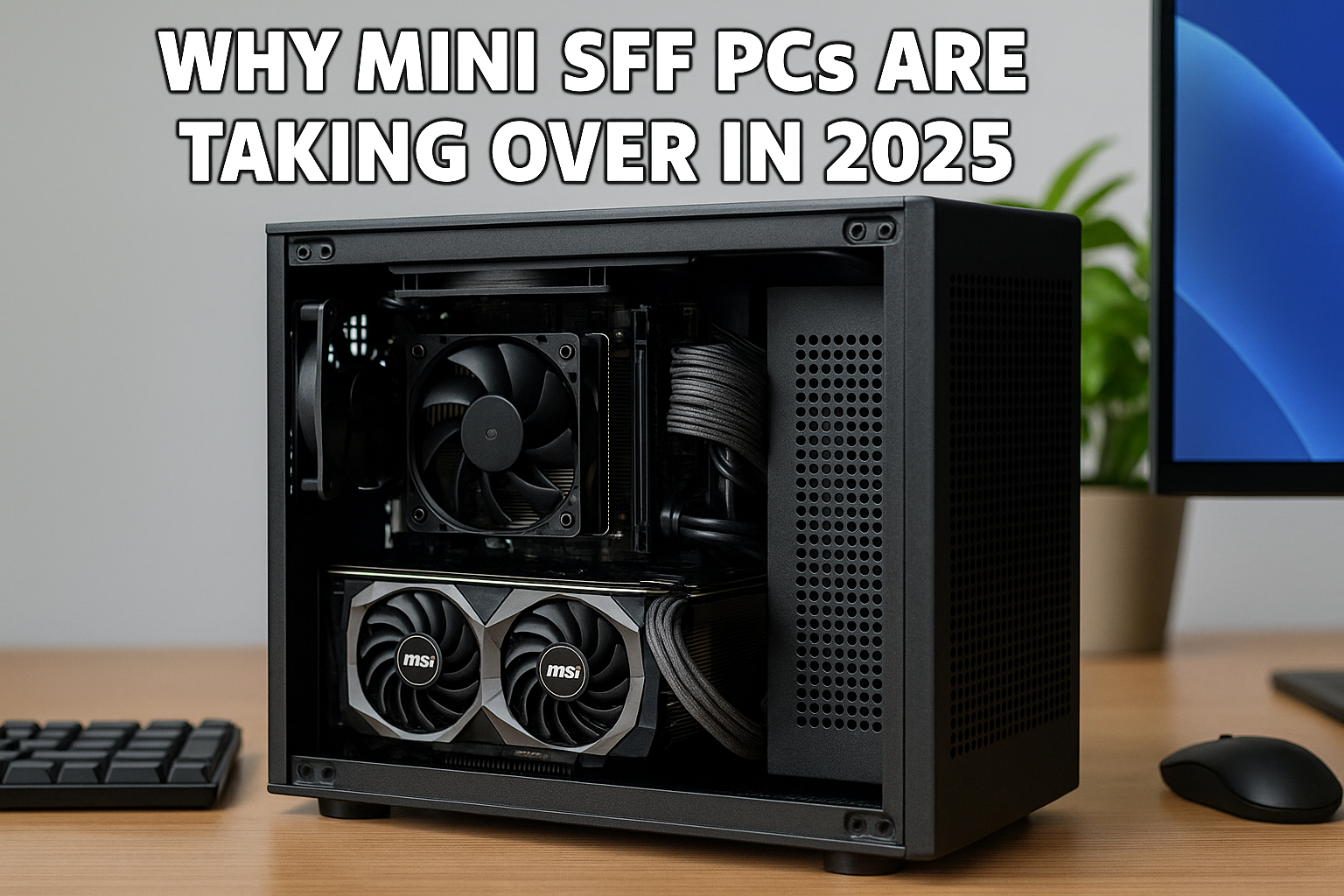
The world of desktop computing is getting smaller—literally. In 2025, Small Form Factor (SFF) PCs are no longer niche projects for tech enthusiasts.
They’ve gone mainstream, offering powerful performance in ultra-compact designs that rival—and often surpass—traditional full-size desktops.
Whether for gaming, content creation, office work, or home entertainment, Mini SFF builds are becoming the preferred choice for many.
In this guide, you’ll learn why Mini SFF PCs are dominating in 2025, what advantages they offer, how to plan your build, and what hardware works best in these tight enclosures.
What Is a Mini SFF PC?
A Mini Small Form Factor (Mini SFF) PC is a computer built inside a case significantly smaller than a traditional mid-tower or full-tower chassis.
These systems are designed to save space without sacrificing too much performance. Many use ITX or smaller motherboards, low-profile components, and creative airflow solutions.
While SFF used to imply trade-offs, modern technology has changed that. Today’s Mini SFF builds can include high-end CPUs, GPUs, NVMe storage, and advanced cooling—all in volumes as small as 5 to 10 liters.
Why Are Mini SFF PCs So Popular in 2025?
Compact Living and Workspace Trends
Urbanization and remote work have changed how people use space. Desks are smaller, home offices are integrated into bedrooms, and setups need to be clean, portable, and efficient. A 40-liter PC tower simply doesn’t fit modern lifestyles.
Mini SFF PCs meet the need for minimalism without sacrificing performance.
Aesthetic Appeal
A sleek Mini SFF system looks clean, modern, and clutter-free. Paired with a wireless mouse and keyboard, it creates a workstation or gaming setup that’s stylish and functional.
Portability
Want to bring your gaming rig to a friend’s house or LAN party? Need a high-powered workstation you can move easily between rooms or even travel with? Mini SFF PCs are small enough to fit in backpacks or travel bags, yet powerful enough to compete with desktops.
Power and Efficiency
With advances in chip architecture, CPUs and GPUs now deliver more performance per watt. That makes compact systems more viable than ever. A 65W CPU and a 180W GPU can provide incredible power without overwhelming the thermal design of a Mini SFF case.
Who Should Consider a Mini SFF PC?
Mini SFF builds are ideal for:
Gamers who want a portable console-style PC
Remote workers seeking a clean desk setup
Content creators who need performance but lack space
Home theater PC (HTPC) users
Digital nomads and professionals who travel with tech
Anyone tired of giant towers and cluttered cables
Common Mini SFF Case Sizes and Layouts
Mini SFF PCs come in several sizes and layouts. The key is internal volume, typically measured in liters.
Popular Sizes:
5L–8L: Ultra-compact. Only supports low-profile GPUs or integrated graphics.
8L–12L: Moderate space for dual-slot GPUs and compact coolers.
12L–15L: Room for full-size GPUs and tower coolers or AIOs.
15L–20L: Larger cases that still count as SFF but offer fewer compromises.
Layout Styles:
Sandwich-style: GPU and CPU are placed on opposite sides with a central spine
Shoebox: Horizontal or vertical layout with side-by-side components
Stacked: Components sit on top of each other for vertical height savings
Convertible: Supports both horizontal and vertical orientations
Best Cases for Mini SFF Builds in 2025
FormD T1 V2.1 (9.5L)
Premium sandwich layout
Fits RTX 4070-class GPUs
Supports 240mm AIOs
Aircraft-grade aluminum design
Cooler Master NR200P MAX (18L)
Comes with PSU and AIO pre-installed
Compatible with full-size GPUs
Excellent thermals for the size
Easy to build in, even for beginners
Lian Li A4-H2O (11L)
Minimalist aesthetic
Built for water cooling
Efficient use of space
Perfect for Ryzen 7000 or Intel Ultra builds
SSUPD Meshroom S (14.9L)
Extremely modular
Outstanding airflow
Custom loop ready
Can house RTX 4090 in ITX form
Key Hardware Considerations for Mini SFF
CPU
Use a 65W TDP CPU or undervolt higher chips
Best choices include:
AMD Ryzen 7 8700G (APU with Radeon 780M)
Intel Core Ultra 7 155H (Arc iGPU, efficient)
AMD Ryzen 5 7600 (6-core, low power draw)
Intel i5-13400F (budget-friendly, great performance)
Cooler
Height and airflow are limited. Pick carefully:
Noctua NH-L9i or L12S (top-down air)
ID-COOLING IS-55 (compact and quiet)
240mm AIO (if case supports it, like T1 or A4-H2O)
Thermalright AXP120-X67 (excellent for price)
GPU
Check GPU length, height, and width—many cases only fit 2-slot designs.
Best compact GPUs in 2025:
NVIDIA RTX 4060 or 4070
AMD RX 7600 XT
Intel Arc A770 Low-Profile
Sapphire Pulse series (short PCB)
RAM
Always go with low-profile modules if vertical space is tight. 32GB DDR5 is standard for performance Mini SFF builds.
PSU
Look for SFX or SFX-L power supplies:
Corsair SF750 (platinum-rated)
Cooler Master V850 SFX Gold
Lian Li SP750
Be Quiet! SFX Power 3
Modular cables and flat wiring help immensely during cable management.
Storage
Use NVMe M.2 drives to save space and cable clutter:
Samsung 980 Pro
WD Black SN850X
Crucial P5 Plus
2TB drives are now affordable and ideal for a clean setup
Building Tips for Mini SFF PCs
Plan your layout before assembling
Use modular or custom-length cables
Install CPU cooler and RAM before mounting the board
Route cables behind the motherboard tray if possible
Test thermals before sealing the case
Use positive pressure airflow (1 intake + 1 exhaust)
Check GPU riser cable compatibility and clearance
Thermal Management Strategies
Mini SFF cases have limited airflow. Here’s how to keep temps under control:
Use mesh panels wherever possible
Avoid blower-style GPUs—opt for axial fans
Undervolt the CPU and GPU for better thermals
Consider side panel fans for sandwich layouts
Apply high-quality thermal paste (Thermal Grizzly, Arctic MX-6)
Limit background apps during gaming sessions
Are Mini SFF Builds Harder to Maintain?
They can be, especially during the initial build. Once completed, they’re easy to maintain with some care:
Clean dust filters monthly
Monitor temps regularly with HWInfo or CoreTemp
Use software like FanControl to fine-tune airflow
Avoid overclocking unless cooling is top-tier
Leave some breathing room behind the case
Real-World Use Cases
For Gamers
Pair a Ryzen 7 7800X3D with an RTX 4070 inside a FormD T1 and enjoy 1440p gaming in a case the size of a shoebox.
For Content Creators
Use a Core Ultra 7 with integrated Arc graphics for video editing in DaVinci Resolve or Adobe Premiere inside a Lian Li A4-H2O.
For Office or Remote Work
Use a Ryzen 8700G inside a Meshroom S with silent cooling for a clean, clutter-free desk setup with integrated Radeon 780M graphics.
For Media and Streaming
Build a silent HTPC with Intel UHD 770 graphics and fanless cooling in a 5L case for Netflix, YouTube, and light Steam gaming on your TV.
Future of Mini SFF PCs
Mini SFF PCs are only getting better. As CPUs and GPUs become more efficient and components shrink, the performance gap with full-tower builds continues to close.
We’re seeing more innovation in:
Stacked GPUs and split PCBs
Fanless and vapor chamber cooling
Wireless-only builds
Cases with 3D-printed modular parts
Tiny systems with support for PCIe 5.0 and DDR5-8000
By 2026, a 10L PC could outperform a traditional 30L desktop with better acoustics and lower power draw.
Final Thoughts
Mini SFF PCs are no longer just for enthusiasts—they’re for everyone. Whether you want a clean workstation, a portable gaming rig, or a compact content creation machine, building in a small form factor offers freedom, flexibility, and a modern aesthetic.
With careful planning, the right components, and smart airflow management, you can enjoy the full power of a desktop in a footprint smaller than a console. The future of PC building is compact—and it’s already here.

Chris Dalton is a tech enthusiast with a passion for helping others build high-performance PCs on a budget. He shares practical advice, in-depth guides, and honest insights to empower freelancers, gamers, and creators to get the most out of their hardware. With hands-on experience and a focus on smart, affordable solutions, Carlos Eduardo turns complex tech into accessible knowledge for all.