
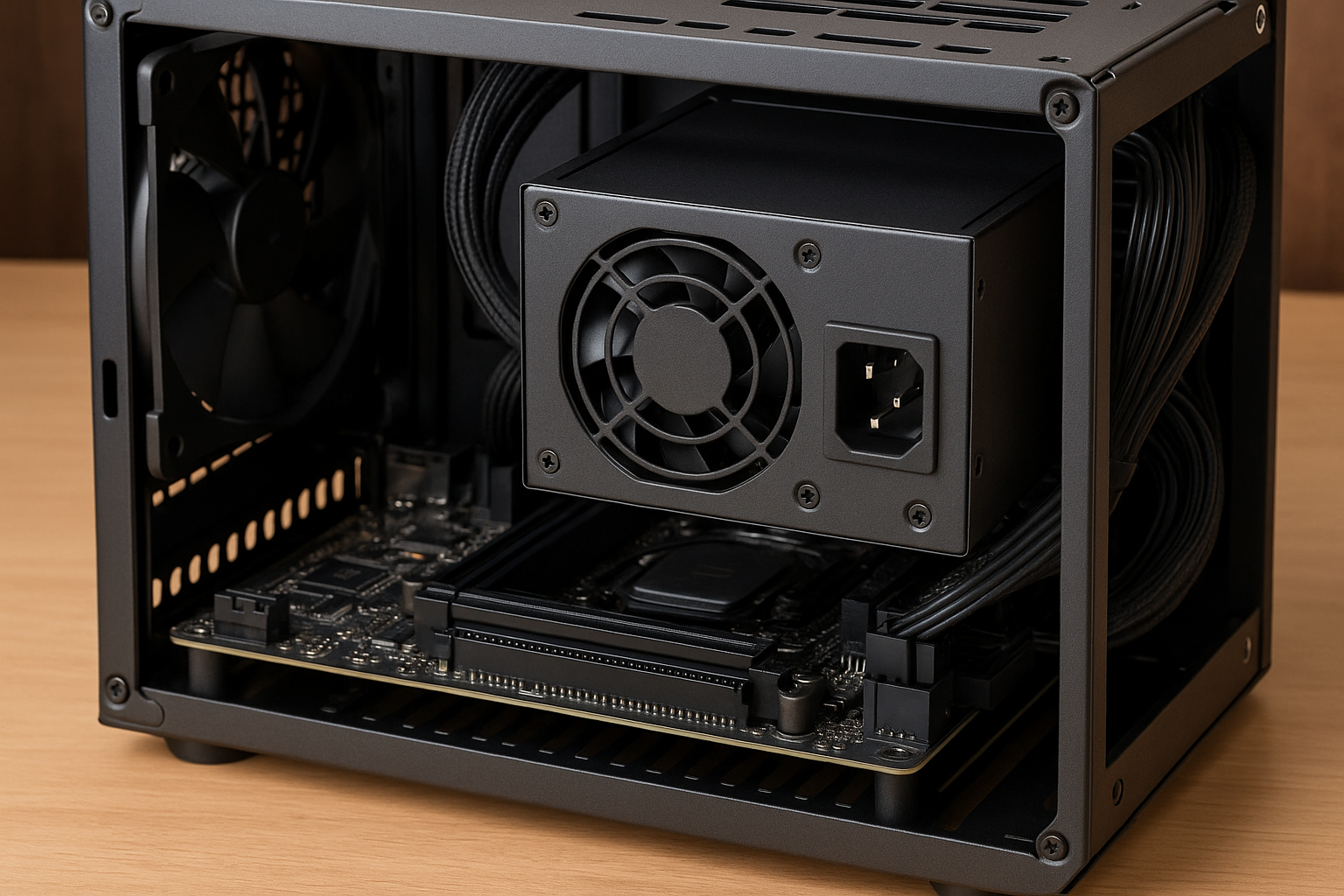
Choosing the right power supply is one of the most important decisions when building a Mini SFF PC. In small form factor systems, the power supply influences far more than just power delivery.
Because space is limited, the PSU directly affects airflow, thermals, noise levels, and cable management. A poor choice can turn an otherwise excellent build into a hot, loud, and frustrating system.
In 2025, SFX and SFX-L power supplies have evolved significantly. They are more efficient, quieter, and capable of handling powerful components. Understanding how to choose the right model is essential for a successful Mini SFF build.
Why the Power Supply Is Critical in Mini SFF Builds
In a Mini SFF PC, components are packed tightly together.
Unlike ATX cases, there is little room for excess heat to escape. The power supply often sits just millimeters away from the GPU or CPU cooler.
This means the PSU contributes directly to internal temperatures. A low-efficiency unit generates more heat, increasing fan noise and thermal stress across the system.
A well-chosen PSU improves airflow paths and helps maintain stable temperatures under load.
Understanding SFX and SFX-L Power Supply Standards
SFX and SFX-L are compact PSU formats designed specifically for small cases.
SFX power supplies are the most compact standard available. They are widely supported and fit in nearly all Mini ITX and SFF cases.
SFX-L power supplies are slightly longer. This extra length allows manufacturers to use larger fans, usually resulting in quieter operation.
The key difference is size, not power delivery. Both formats can deliver high wattage efficiently when built properly.
Physical Size and Case Compatibility
Physical dimensions matter more than wattage in SFF systems.
Some cases support only SFX units, while others support both SFX and SFX-L. Installing an incompatible PSU can block airflow or prevent other components from fitting.
Before choosing a PSU, always check:
- Maximum PSU length supported
- PSU mounting orientation
- Clearance near the GPU and CPU area
Even a few extra millimeters can make or break a Mini SFF build.
How Much Wattage Do You Really Need?
Overestimating wattage is one of the most common mistakes.
Modern CPUs and GPUs are far more power-efficient than older generations. Most Mini SFF systems do not need extremely high wattage PSUs.
Typical wattage recommendations:
- 450W to 550W for mid-range builds
- 600W to 750W for high-performance builds
- 850W only for top-tier GPUs and CPUs
Choosing the right wattage improves efficiency and reduces excess heat.
Efficiency Ratings and Why They Matter
Efficiency ratings play a major role in SFF builds.
Higher efficiency means less wasted power and less heat generated inside the case. This is especially important in compact environments.
Look for PSUs with:
- 80 Plus Gold as a minimum
- 80 Plus Platinum for premium builds
- Stable efficiency at low and medium loads
Higher efficiency results in quieter fans and better long-term reliability.
Fan Size and Noise Levels
Fan noise is a major concern in Mini SFF PCs.
SFX power supplies usually use smaller fans that spin faster, which can increase noise under load. SFX-L models often include larger fans that operate at lower RPMs.
If silence is a priority:
- Prefer SFX-L when your case allows it
- Look for semi-passive fan modes
- Check noise-focused reviews
A quiet PSU improves the overall experience of using a compact PC.
Cable Quality and Flexibility
Cables are often overlooked but extremely important.
Rigid cables can block airflow and make assembly difficult. In small cases, cable flexibility directly affects cooling performance.
The best PSUs for Mini SFF builds offer:
- Fully modular designs
- Soft, flexible cables
- Shorter cable lengths optimized for SFF
Some builders also use custom cables to maximize airflow and aesthetics.
Single Rail vs Multi Rail Designs
Power rail design impacts stability and safety.
Single-rail PSUs provide all power through one rail, simplifying compatibility. Multi-rail PSUs distribute power across multiple rails, offering additional protection.
For most Mini SFF builders:
- Single-rail designs are simpler
- Multi-rail designs offer enhanced safety
Both options work well when sourced from reputable manufacturers.
Reliability and Brand Reputation
In compact systems, reliability is critical.
A PSU failure in a Mini SFF build can be harder to diagnose and more disruptive due to tight assembly. Choosing a trusted brand reduces long-term risk.
Look for:
- Long warranties (7 to 10 years)
- Consistent performance reviews
- Proven track records in SFF markets
A reliable PSU protects every component in your system.
Thermal Performance Under Load
SFF systems often run closer to thermal limits.
A good PSU maintains stable temperatures even under sustained loads. Poor thermal performance increases internal heat and triggers louder fan behavior.
High-quality PSUs use:
- Better internal layouts
- Higher-grade components
- Smarter fan curves
This leads to more stable performance during gaming or productivity tasks.
Modular vs Non-Modular in SFF Builds
Non-modular PSUs are rarely ideal for Mini SFF builds.
Unused cables take up precious space and restrict airflow. Fully modular designs allow you to connect only what you need.
For Mini SFF systems:
- Fully modular is strongly recommended
- Semi-modular can work in some cases
- Non-modular should be avoided
Cable control is essential in compact environments.
Planning for Future Upgrades
Even in small systems, future upgrades matter.
Choosing a PSU with a small wattage buffer allows for GPU or CPU upgrades later. However, too much excess wattage can reduce efficiency.
Aim for:
- 20 to 30 percent headroom
- Compatibility with newer GPU connectors
- Proven support for high transient loads
This ensures your build remains relevant longer.
Balancing Performance, Size, and Noise
The best Mini SFF PSU is not the most powerful one.
It is the one that balances size, efficiency, noise, and cable management. In small builds, balance always beats excess.
A thoughtfully chosen PSU enhances the entire system rather than limiting it.
Making the Right Choice in 2025
In 2025, Mini SFF power supplies are better than ever.
With the right SFX or SFX-L model, you can build a compact system that is powerful, quiet, and reliable. Understanding your case limitations and component needs is the key to success.
Choosing the right power supply sets the foundation for a Mini SFF PC that performs consistently and lasts for years.

Chris Dalton is a tech enthusiast with a passion for helping others build high-performance PCs on a budget. He shares practical advice, in-depth guides, and honest insights to empower freelancers, gamers, and creators to get the most out of their hardware. With hands-on experience and a focus on smart, affordable solutions, Carlos Eduardo turns complex tech into accessible knowledge for all.