
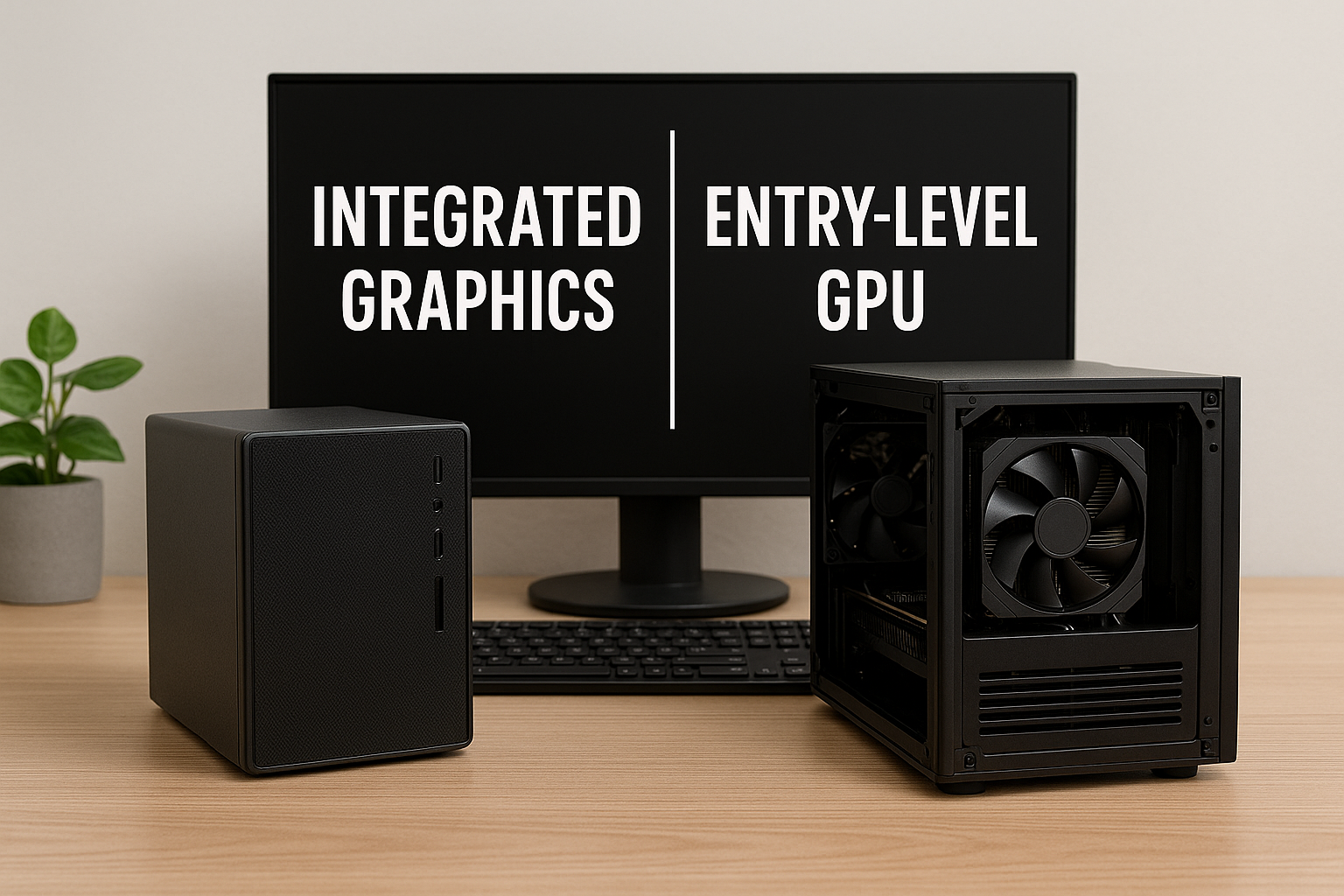
In 2025, the question of whether you should invest in a dedicated graphics card is more nuanced than ever.
With significant advancements in integrated graphics (iGPU) performance from AMD and Intel, many users are now asking: Is a dedicated GPU still necessary for gaming—or is integrated graphics enough?
In this comprehensive comparison, we’ll evaluate how the newest iGPUs stack up against entry-level dedicated GPUs in performance, cost, power, and real-world use cases.
Whether you’re building a budget gaming rig, upgrading an old desktop, or configuring a small form factor PC, this guide will help you decide which graphics solution is best for your needs.
What Are Integrated Graphics?
Integrated graphics are built into the processor (APU or CPU). Instead of a separate card, your computer uses the chip’s internal GPU to process graphics.
Key Features:
- Shared system memory (uses RAM instead of dedicated VRAM)
- Less power consumption
- Smaller form factor (no dedicated slot or cooling needed)
- Present in laptops, mini PCs, and entry-level desktops
2025 Standout iGPUs:
- AMD Radeon 780M – Found in Ryzen 8700G
- AMD Radeon 760M – Found in Ryzen 8600G
- Intel Arc iGPU – Built into Intel Core Ultra 5/7
- Intel UHD 770 – In Core i5-13400 / i7-13700
What Are Entry-Level Dedicated GPUs?
Entry-level GPUs are discrete graphics cards designed for basic gaming and graphics workloads. They’re installed separately in the PCIe slot and come with their own video memory (VRAM).
Popular Models in 2025:
- NVIDIA GeForce GTX 1650 / GTX 1630
- AMD Radeon RX 6400 / RX 6500 XT
- Intel Arc A380 / A310
These GPUs typically cost between $100 and $180 and offer modest performance for 1080p gaming.
Performance Comparison: iGPU vs Entry-Level GPU
Let’s compare performance in popular games between the Radeon 780M and typical entry-level GPUs.
1. Valorant (1080p – Medium Settings)
- Radeon 780M (iGPU): 110 FPS
- RX 6400: 135 FPS
- GTX 1650: 140 FPS
2. Fortnite (Performance Mode)
- Radeon 780M: 80 FPS
- RX 6400: 100 FPS
- GTX 1650: 95 FPS
3. Cyberpunk 2077 (Low Settings – 720p)
- Radeon 780M: 30 FPS (playable with FSR)
- RX 6500 XT: 45 FPS
- Arc A380: 40 FPS
4. Apex Legends (Low – 1080p)
- Radeon 780M: 60 FPS
- GTX 1630: 70 FPS
- RX 6400: 85 FPS
5. Minecraft Java (Shaders Off)
- Radeon 780M: 100+ FPS
- All Entry GPUs: 120–180 FPS depending on RAM and drivers
Summary:
Integrated graphics are now powerful enough for most esports and indie titles. However, dedicated entry-level GPUs still have an edge in VRAM-intensive games and more demanding 3D titles.
VRAM: Dedicated GPUs Have the Advantage
Most iGPUs rely on system RAM, which is slower and shared with the CPU. In contrast, entry-level GPUs usually have:
- 2GB to 4GB VRAM (GDDR5 or GDDR6)
- Faster memory bandwidth
- Better handling of textures and open-world assets
This matters in games like:
- Assassin’s Creed series
- Call of Duty
- Hogwarts Legacy
- Modern racing simulators
If you’re planning to play AAA games—even at low settings—VRAM becomes a bottleneck on iGPUs.
Cost Comparison
| Graphics Type | Total System Cost (Est.) | Notes |
|---|---|---|
| Radeon 780M (Ryzen 8700G APU) | $450–$600 | Includes CPU + iGPU in one chip |
| GTX 1650 + i3-12100F | $550–$650 | GPU adds $140+ |
| RX 6500 XT + Ryzen 5 5600 | $600–$700 | Slightly better gaming, higher cost |
| Intel Arc A380 + Core i3-13100 | $500–$600 | Good entry combo |
With an iGPU, you don’t need a high-wattage PSU, PCIe slot, or bulky case. This leads to savings in other components too.
Power Efficiency and Thermals
Integrated graphics use less power, which translates to:
- Quieter operation
- Cooler temperatures
- Lower electricity bills
- Smaller power supplies (300–400W sufficient)
Entry-level GPUs, especially from AMD, often run hotter and require better airflow or larger cases.
Upgradability and Flexibility
Integrated Graphics
- You’re locked into the APU’s performance
- To upgrade graphics, you must install a discrete GPU or change the CPU
- Ideal for SFF builds or laptops where space is tight
Dedicated GPUs
- Can be swapped easily for future upgrades
- Add flexibility if you start with a basic GPU and plan to improve later
- Require bigger cases, better cooling, and stronger PSUs
Use Case Breakdown
Here’s what each option is best for:
Choose Integrated Graphics if:
- You’re gaming on a budget (under $600 total)
- You want a quiet, energy-efficient PC
- You’re playing mainly indie or esports titles
- You need a compact build (HTPC or Mini ITX)
- You’re not planning AAA gaming or VR
Choose Entry-Level GPU if:
- You need more VRAM for 3D or AAA titles
- You want better 1080p performance
- You plan to upgrade gradually
- Your games benefit from dedicated drivers and higher texture detail
- You’re building a larger ATX system with airflow and upgradeability
Driver Stability and Compatibility
iGPU drivers have matured, especially with AMD’s Adrenalin software. Intel Arc drivers were shaky at first, but by mid-2025, they’re stable for most games.
That said, dedicated GPUs still tend to receive:
- Faster driver updates for new game releases
- Optimizations for modern engines (Unreal Engine 5, Unity HDRP)
- Better Vulkan and ray tracing support (though limited on entry GPUs)
Integrated Graphics for Non-Gamers
Even if you’re not gaming, iGPUs are ideal for:
- Media centers (4K video playback, streaming)
- Basic photo/video editing
- Office productivity
- Programming and web development
- Remote workstations
For these tasks, there’s no need for a dedicated GPU.
Are Entry-Level GPUs Becoming Obsolete?
With Radeon 780M offering GTX 1650-level performance, you might wonder if low-end GPUs are even worth it.
Here’s what’s changing:
- APU performance now rivals 4–5 year-old discrete GPUs
- AMD and Intel are pushing better iGPUs every generation
- Cloud gaming is taking pressure off local hardware
- Game optimization for integrated systems is improving
However, for users needing dedicated VRAM, support for higher resolutions, or future GPU upgrades, entry-level GPUs still hold value—just not as much as before.
Final Verdict
The gap between integrated graphics and entry-level GPUs has narrowed dramatically. If you’re on a budget, building small, or focused on esports and indie games, integrated graphics (like the Radeon 780M or Intel Arc iGPU) offer fantastic value.
But if your goal is more graphically intensive gaming, future upgrades, or VRAM-dependent performance, then a dedicated entry-level GPU like the RX 6500 XT may still be the better choice.
Ultimately, it comes down to your needs. Both options are valid—but 2025 marks the year when integrated graphics finally became a legitimate alternative, not just a compromise.

Chris Dalton is a tech enthusiast with a passion for helping others build high-performance PCs on a budget. He shares practical advice, in-depth guides, and honest insights to empower freelancers, gamers, and creators to get the most out of their hardware. With hands-on experience and a focus on smart, affordable solutions, Carlos Eduardo turns complex tech into accessible knowledge for all.